Best Fitness Trackers for Kids (2026): Fun, Safe & Simple
A tracker can turn moving around into a game for kids — but the priorities are different from an adult’s. You want something durable, parent-controlled, motivating, and light on data collection and screen time. Below are our 2026 picks across ages, with honest notes on what’s appropriate for whom.
A note for parents: consider privacy, age requirements and screen time. Dedicated kids’ trackers keep data in a parent-controlled app with no social features; general trackers (like Fitbit) have account age minimums and more app/notification features.
Quick Picks
Best overall: Garmin vívofit jr. 3
Made for kids — parent app, chores, adventures, ~1-year battery, swim-friendly.
Best for tweens/teens: Fitbit Inspire 3
A “real” tracker for older kids — heart rate, sleep, ~10-day battery.
Simplest: 3DFitBud
Just steps — no app, no account, no screen time. Great for young kids.
How we chose
We don’t lab-test every device. These picks are based on what matters for kids — durability, parental controls, motivation, battery, privacy and age-appropriateness — plus the consensus of reviewers and verified owners. Links are affiliate links; we may earn a commission at no cost to you, with no paid placements. See our methodology.
The picks
Garmin vívofit jr. 3 — Best overall
Purpose-built for children, the vívofit jr. 3 turns activity into app adventures and mini-games, lets parents assign chores and rewards, and is swim-friendly and tough — all on a ~1-year replaceable battery with no charging. Crucially, data stays in the parent-controlled app with no social features. The standout choice for younger kids.
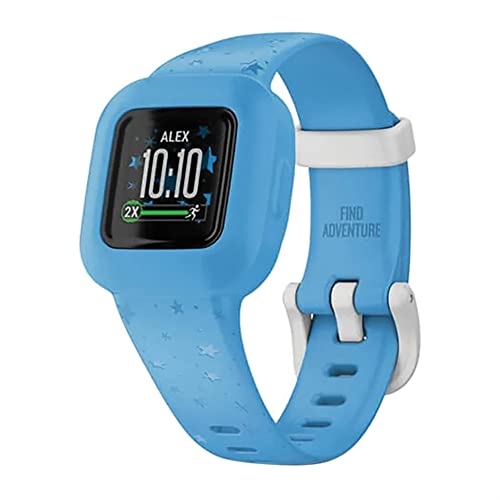
Garmin vívofit jr. 3 (Kids Fitness Tracker)
- ✓Designed for kids and parents
- ✓Motivating games and rewards
- ✓~1-year battery, no charging
- ✓Durable and swim-friendly
- ✕Basic fitness metrics
- ✕Character themes may not suit older kids
Fitbit Inspire 3 — Best for tweens & teens
Older kids often want a “real” tracker. The Inspire 3 is light, durable and affordable, with heart rate, sleep and ~10-day battery. Note Fitbit accounts have an age minimum (with a parent/guardian-managed family account option) and the app adds notifications and some social features — better suited to tweens and teens than little ones.

Fitbit Inspire 3
- ✓Feels like a grown-up tracker
- ✓~10-day battery
- ✓Reliable everyday tracking
- ✓Works with iPhone and Android
- ✕Account age minimums apply
- ✕More app/social features to manage
3DFitBud — Simplest (and most private)
For young children, sometimes the best option is the simplest: the 3DFitBud just counts steps on a big display, with no app, no account and no data collection — and a ~1-year battery. No screen time, no privacy worries, and it clips on or fits a pocket too.

3DFitBud Simple Step Counter
- ✓No app, account or data collection
- ✓Dead simple for young kids
- ✓~1-year battery
- ✓Very cheap
- ✕Steps only (no HR/sleep/games)
- ✕No motivation features
At a glance
| Model | Best age | App / account | Battery | Notes |
|---|---|---|---|---|
| Garmin vívofit jr. 3 | ~4–10 | Parent-controlled, no social | ~1 year | Games, chores, swim-friendly |
| Fitbit Inspire 3 | Tween/teen | Fitbit (age minimums) | ~10 days | ”Real” tracker features |
| 3DFitBud | Young kids | None | ~1 year | Most private, steps only |
What to look for in a kids’ tracker
Parental controls & privacy. Favour devices that keep data in a parent-managed app with no open social features. Check age requirements for general-purpose trackers.
Durability & battery. Kids are tough on gear and bad at charging — swim-friendly builds and long (or replaceable) batteries win.
Motivation, not pressure. Games, badges and chore rewards (Garmin) encourage activity in a healthy way. Avoid turning it into calorie-counting for children.
Screen time. A simple step counter sidesteps screens and notifications entirely — sometimes the healthiest option for younger kids.
Related guides
- the best smartwatches for small wrists — for older kids and small adult wrists alike.
- what size tracker to buy — how to measure before you order.
FAQs
What is the best fitness tracker for kids in 2026?
The Garmin vívofit jr. 3 is best overall for younger children — parent-controlled, motivating, swim-friendly and ~1-year battery. The Fitbit Inspire 3 suits tweens and teens who want a "real" tracker, and the 3DFitBud is the simplest, most private option.
Is there an age limit for kids' fitness trackers?
Dedicated kids' trackers like the Garmin vívofit jr. 3 are designed for young children with parent controls. General trackers such as Fitbit have account age minimums and family-account options, so they're better for tweens and teens.
Are fitness trackers safe and private for children?
Choose devices that keep data in a parent-managed app with no social features. The most private option is a simple step counter with no app or account at all, like the 3DFitBud.
Should kids track calories or just activity?
For children, focus on activity, movement and fun — not calorie counting. Games, step goals and rewards encourage healthy habits without the pressure of dieting metrics.
Affiliate disclosure: As an Amazon Associate we earn from qualifying purchases. Links above are affiliate links and may earn us a commission at no extra cost to you.